| +48 22 810 80 17 | biuro@mikrolab.waw.pl |

You are here: Blog Fungi and molds in our environment – what do we use to test?
Fungi and molds in our environment – what do we use to test?
We most often associate mold with a green coating on bread or black spots on a damp wall. However, microscopic fungi are much more common than you might think. Their spores are a natural part of the environment and can be found in the air, on surfaces, in water, and in building materials, among other places.
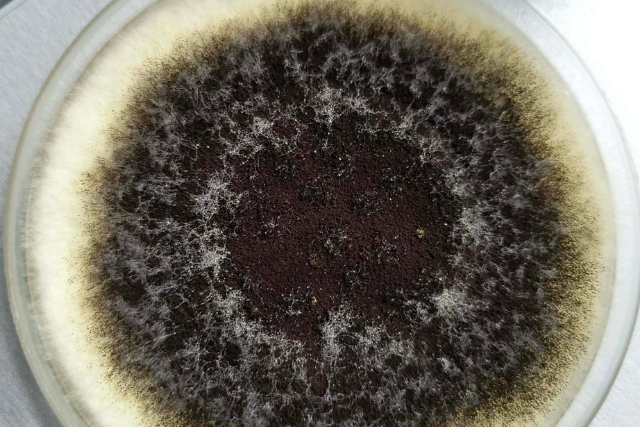
The photo shows a fungal colony grown in a laboratory. Such cultures allow us to determine whether fungi are present in a given sample and to estimate their quantity.
Why is it worth researching at all?
The mere presence of fungi doesn't necessarily mean there's a problem. The location, quantity, and type of microorganisms detected are key factors.
Problems can arise when fungi begin to multiply rapidly. This is primarily facilitated by moisture, inadequate ventilation, and inadequate temperature. Therefore, their presence can be significant in damp rooms, ventilation and air conditioning systems, and certain manufacturing processes.
That's why microbiological testing isn't just about finding "something that grew." What matters is accurately assessing the results and answering the question of whether the number and type of microorganisms detected pose a problem in a particular environment.
Mushrooms that you can't see
On a daily basis, we can't assess how many microorganisms are present in the air or on the surface being examined. A characteristic odor or visible mold isn't always present.
Microbiological testing allows us to look a little deeper and check what cannot be assessed with the naked eye.
And sometimes the test result looks just like this – one sample, one medium and a colony that tells us much more than you might think.